
- News
- City News
- chennai News
- Safe among the crowd? Women commuters in Chennai say `no'
Trending
This story is from June 14, 2017
Safe among the crowd? Women commuters in Chennai say `no'
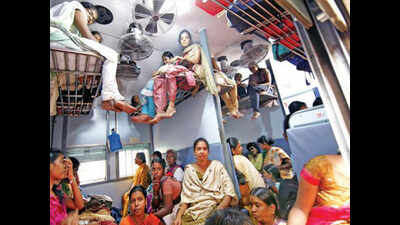
By investing more on transport, government can avoid crowding and make commuting safe for women, say experts.
Five months before the murder, the city was rated the safest in the country by a global consultancy firm. But one year after the incident, that belief is eroding.
In a survey covering 1,800 respondents, 70% said women faced the risk of being groped or harassed when taking public transport.

“About 90% of women walk or use public transport while that number for men is between 65% and 70%,“ said South Asia director for Institute for Transportation & Development Policy (ITDP), Shreya Gadepalli.
“(But) there are no safety mechanisms for such women. The state is responsible for providing it,“ said senior advocate of the Madras high court R Vaigai. “The Nirbhaya fund hasn't translated into action, the Justice Verma committee report has been dumped. Amending laws is not enough. The society and system need to transform together.“
A safer transport system would ensure greater participation of women in the workforce, say experts. “About 15% men cycle while it is less than 2% among women because women on cycles are still seen as taboo,“ said Gadepalli. “The
Tamil Nadu government giving away free cycles for school students is a big step as it enhances their ability to move,“ she said adding that a research conducted in New Delhi showed that household maids who cycled made more money than those who did not. “If more women have access to mobility , more opportunities will be available to them,“ she said.
To increase safety for women, experts say the government has to invest more in public transport, maximise its fleets and prevent crowding.For instance, the 3,500-odd buses operating in the city run on twice their capacity . In the survey , 80% respondents said they were more at risk of being sexually harassed inside a crowded transport vehicle. “Most people and staff are unaware of how to handle complaints and women still fear to call for attention,“ said founder of AWARE, Sandhiyan Thilagavathy .
An official of the safety department of the MTC said checks were limited to investigating road accidents. “Our drivers and conductors are morally responsible towards women. If anything happens to them inside the bus, they have to help the woman file complaints,“ the official said.
End of Article
FOLLOW US ON SOCIAL MEDIA










Hot Picks
TOP TRENDING
Trending Stories
In City
Entire Website
- The Secret Behind NFL Marriages: How These Couples Make It Work
- UPI transaction limit to change from September 16! Here are the new limits for various UPI payments
- When Laura Loomer said she's single because she's too focused on Donald Trump
- South Delhi shooting: Sleuths see killing as a message to big businessmen
- Top 10 sports stars turned power couples: From Agassi-Graf to Conner-Comaneci
- 3 Zodiac Signs Most Likely to Become Multimillionaires
- Narayana Murthy faces backlash for parenting remarks on social media; users say, "after working 72 hours a week, there’s barely time left to have babies…”
- 'Would not fit in ... ': Princess Diana's brother warned Prince Harry about marrying Meghan Markle
- The 3 Strongest Zodiac Signs: Powerhouses of the Zodiac Wheel
- Dark Side Of Each Zodiac Sign
- 'Nothing will slow me down': Trump after apparent assassination attempt
- Trump shooting incident: 'Shooter was only 400-500m away' - Key details
- Why you should not be fooled by ‘20-year SIP crorepati’ dream
- Arvind Kejriwal's resignation: Who will be the next Delhi CM?
- Process for census initiated, 'open' on caste count: Govt
- How Sachin Tendulkar mastered the upper cut shot to perfection
- Why cow vigilantes killing a Brahmin is the wake-up call India needed
- Apple's biggest 'iPhone update' for 2024: India time, how to prepare
- Joe Biden 'relieved' Trump is safe after apparent assassination attempt
- Kejriwal says he will quit as CM in 2 days, wants aam aadmi's 'honesty certificate'

Popular Categories
Hot on the Web
Top Trends
Trending Topics
World Largest HorseEID WishesEID 2024 WishesPriyanka Chopra TattooKottukkaali OTT ReleaseEngineers Day WishesGoat CollectionHair LossSudha MurtyMalayalam ProducersIndia's Best Dancer 4Simi GarewalDilli BabuIndian National ParksLaung BenefitsVikas SethiApple iPhone 16Donald TrumpAadhar Card UpdateWordle Answer
Living and entertainment
Latest News
Challenges won’t stop me from making films that matter: Aditya Kripalani3 Reasons Why Hell in a Cell Tag Team Match Between Cody Rhodes, Roman Reigns and The Bloodline 2.0 Would Be perfect for Bad Blood 2024Odisha to join Ayushman plan; Delhi, Bengal to be only holdoutsRobert's wild encounter with Henry, the world's oldest 124-year old crocodile; internet shocked | Watch videoHooda says Congress coming to power in Haryana, asks criminals to give up crime or leave state‘I Hate Taylor Swift!’: Donald Trump rages after singer endorses Kamala Harris'Virat bhaiya's passion and dedication for the game is...': Sarfaraz KhanFather-son duo Eugene and Dan Levy's dazzling entrance at the EmmysFather rapes and murders 8-year-old daughter in Madhya Pradesh, throws body in wellBakuchiol: Nature’s answer to youthful skin radianceSaudi Arabia footballer Fahad Al-Muwallad hospitalized after fall from balcony'Will hug my kids extra tight tonight': JD Vance after Trump 'assassination attempt'Bengal govt blames junior docs for logjam but sends fresh offer for talksLodi-era mosque collapses in AgraVineet Kumar Singh calls Superboys of Malegaon standing ovation at TIFF a 'magical experience': 'I can still hear the clapping and whistling" - ExclusiveFoods to pair with dates for boosting immunityNeeraj Chopra misses second Diamond League title by an agonising 1 cm; finishes second behind AndersonRain washes out England-Australia T20I series finale
Copyright © 2024 Bennett, Coleman & Co. Ltd. All rights reserved. For reprint rights: Times Syndication Service